

 A Tree Swallow sitting on a nesting box at Creamer’s Field.
It was a spring day at college in Massachusetts and I was walking along a bike path by campus when suddenly an odd feeling washed over me. I stop walking. After a minute, I saw a Tree Swallow flit through the air above me, and my brain caught up with my body. The Tree Swallows had migrated back up for the summer, and I was subconsciously recognizing their warbling calls, my body telling me “something familiar is here”.
Tree Swallows have an impressive vocabulary. Their most common song, a series of bubbling chirps, I usually hear when they are sitting on top of the nesting box. They will sing alone, but often I see them both sitting on the nesting box singing back and forth. I don’t know what they are saying, but it sure sounds like they are having some sort of conversation. The amazing thing about these vocalizations is that they don’t need to open their beaks to sing. They can sing while flying, preening, and even while holding a huge mouthful of insects. Their song can carry on the air and is loud enough that a Tree Swallow can be flying so far up in the sky that it is invisible to me, save for its high pitched song.
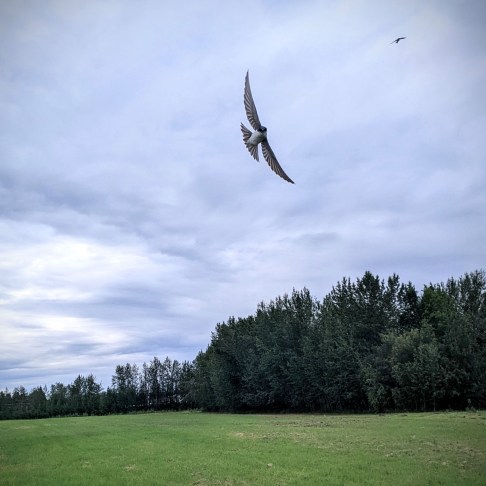
A Tree Swallow flying straight towards me. Notice how its head remains level with the ground, even when its body is sideways.
The swallows can also take advantage of this long distance communication system to form a predator warning system. This summer I noticed that the Tree Swallows have a specific warning call for birds of prey, and when a hawk, falcon, or even a gull flies too close to the nesting area, the call is sounded. Swallows from all over Creamer’s Field hear the distress call and flock to be of aid, diving and yelling at the intruder. It seems to be very effective; I don’t like being yelled at by 50 angry parents either!
Tree Swallows also have an established system to ward off ground predators such as foxes or coyotes. They gang up like they do with the birds of prey, but instead of sounding alarm chirps, they screech and chatter while diving straight at the intruder, boldly diving so close as to almost touch its head. It sure does seem to work well; every fox I have seen too close to the Tree Swallow’s nests ends up turning tail and running for cover.
Tree Swallows flying around Creamer’s Field.
The most endearing interactions between mates occur during the feeding of chicks. When the chicks are still small enough for the female to keep them warm by sitting on them, the male will swoop in with a welcoming chirrup and a mouthful of insects. If the female does not answer him from inside the box, he often won’t go inside, and will instead sit on top, guarding the nest. Only when she reappears will the male go in to feed the chicks. In other instances, the male sits on top of the box while the female sits inside, and when danger threatens, the male gives an alarm and the female flies straight out.
For a species that does not live in colonies and does not mate for life, Tree Swallows are surprisingly social. I always wonder but can never know for sure if individuals recognize past mates, past rivals, siblings, or offspring. Do they migrate with their mates or with their chicks? Do they spend time in the same flocks in their winter ground? Studying Tree Swallows during breeding season allows me to learn so much about their behavior and ecology, but it also opens up many more questions that I may never know the answers to. There is beauty in the mystery of these creatures, and I have realized that some things don’t need to be understood in order to be appreciated. The Tree Swallows have already left Fairbanks to migrate to their winter grounds, so the 2026 field season is over for me. Creamer’s field is eerily quiet without the hustle and bustle of dozens of wings in the air, and it reminds me that I too need to start preparing for winter and flying across the country to go back to college. I am always a bit sad to leave my childhood home for the winter, to leave Fairbanks, and to leave my friends, but it is comforting to know that wherever I am, Alaska or Massachusetts, I am in the home range of the Tree Swallow.