

In 2025, we placed a small metal band with the number 317165534 onto an adult male Tree Swallow’s leg. He and his mate, who was identified by the number 317165463, were nesting at Creamer’s Field Refuge in box number 119. This nest was was of about fifty nests at Creamer’s field monitored by the Alaska Songbird Institute, so we not only know exactly when he and his mate built their nest and when their eggs hatched, but with these two birds’ identification numbers, we also know where they nest at Creamer’s Field in years to come.
This year, we were happy to find that the male and female pair nesting in box number 122, which is right next to 119, were the exact same pair of birds that had nested in box 119 in 2025. Tree Swallows do not mate for life, and will often switch partners in different years, but they often end up in the same pairs as previous years because they are extremely faithful to their nesting location, and both the male and female will return to the same exact nesting box year after year. However, in this case it sure looks like the pair stuck together intentionally, that is until we looked at which birds were nesting in box number 119 this year.
Female Tree Swallow with mostly brown feathers, an indication that she is only one year old.
It turns out that the same male, number 317165534, is also fathering the nest in box 119 this year, with a different female bird, one that did not nest in one of our nesting boxes the year before. One bird fathering two nests is uncommon, but does happen from time to time. Male Tree Swallows do not help to incubate the eggs in their nest, but they do protect the female while she sits on the eggs, so whenever one male fathers two nests, they are always in nesting boxes that are very close to each other. Once the eggs hatch, both the male and female birds start bringing food back for the nestlings, which is a huge investment of energy. Since number 317165534 fathered two nests this year, he had to bring back enough food for 11 nestlings, rather than just five or six.
Despite his ambitious parenting, this year I found that number 317165534 still carried a lot of fat on his body, and weighed almost 22 grams, which is more than most male Tree Swallows. In the event of one male fathering two nests, usually the male benefits, because he has twice as many offspring, and the females do not benefit, because their mate does an inferior job feeding their nestlings. However, number 317165534 must be extremely efficient at catching insects, because his mates from both nests had just as much fat on their body as he did. I suspect that when we measure the nestlings from both nests and place identification bands on their legs, they will be doing just as well as their parents, because number 317165534 seems to do such an incredible job at catching twice as many insects as Tree Swallow parents usually would.
Another example of Tree Swallows surprising me by nesting in ways that are not “normal” is when three birds work together to raise one box of chicks. More than a few times I have seen a second female popping in and out of a box, usually with fully brown plumage indicating she is just one year old, while the other two parents watch unconcernedly. Sometimes the extra female will not even have a brood patch, meaning she never laid any eggs and never sat on any eggs to keep them warm. I am never quite sure how much this extra female bird actually helps out, but I am always fascinated to see a bird migrate all the way up here just to hang out and never actually nest. If I have learned one thing during my summers working with the Tree Swallows, it is that they are always ready to surprise me with some new or unexpected behavior.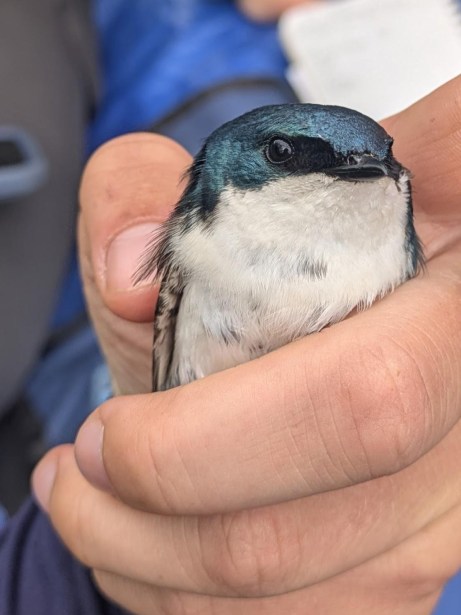
Number 317165534 in 2026