1/16/25

...and celebrating some big wins

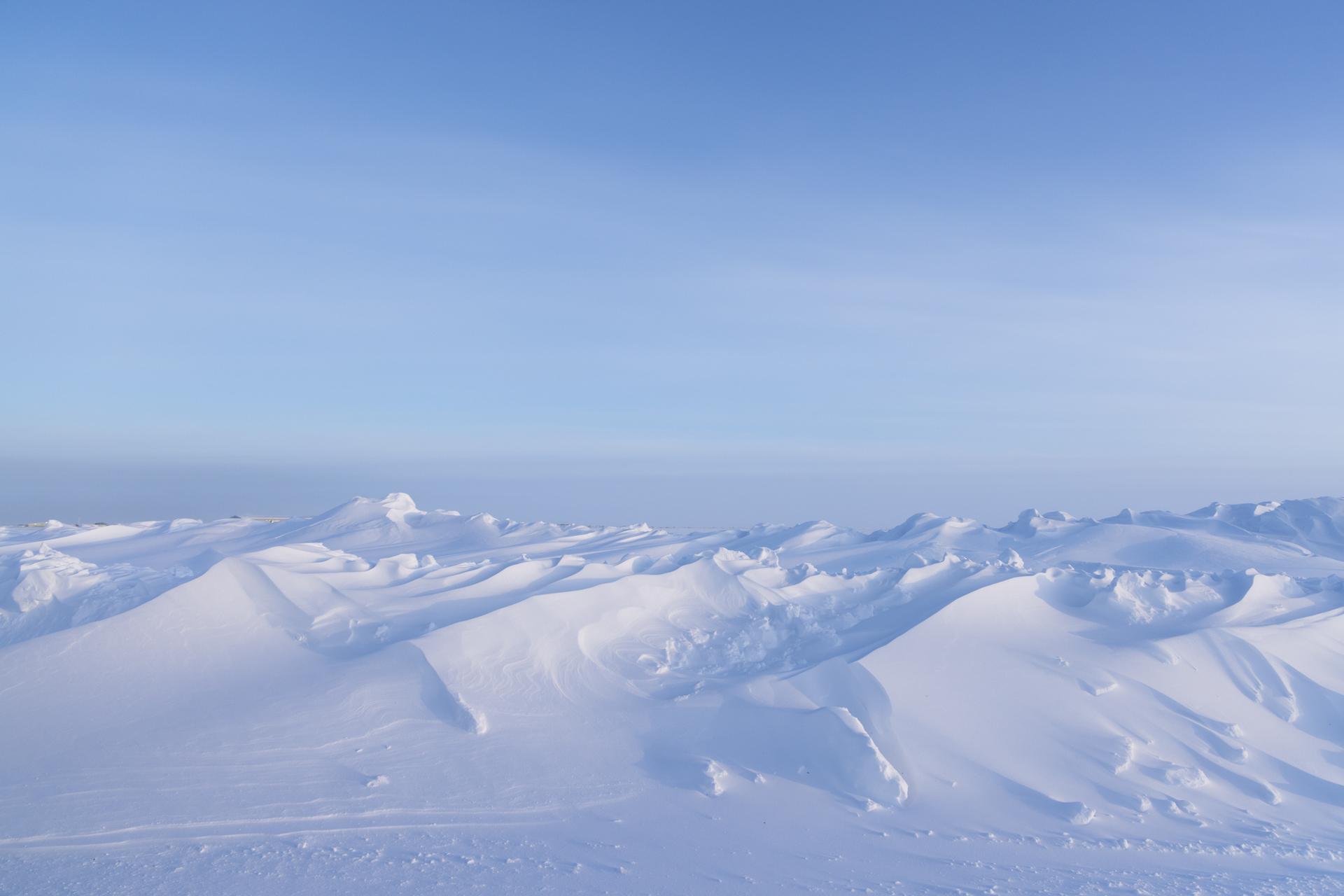
Snow drifts in Utqiagvik. Photo by Emily Sullivan

The start of 2025 feels energized and now more than ever, it's important to share and celebrate conservation wins and the tireless efforts they take, both big and small! We don’t do this work alone, and these celebrations serve as an important reminder that there is power in numbers and so much good work being done on a daily basis. 


In this newsletter, hear about an advocacy trip to Washington D.C., led by Indigenous advocates and members of No Ambler Road with support from Native Movement and the National Parks Conservation Association. Plus, keep reading to learn about some recent Arctic protections put in place by the Biden administration. 


- Emily Mesner (mesner@northern.org)

  Communications Coordinator


In it for the long haul

A colorful pair of binoculars (in navy blue, teal, and orange) rest on the NOCS-branded cardboard box in the snow.

From left to right: Jazmyn Lee Vent, Martha Wood, Karmen Monigold, Eva Downey, Sonny Ahkivgak, Theresa Clark, and Kathleen Peters-Zuray photographed during an advocacy trip to Washington D.C. Photo by Jayme Dittmar 

Jazmyn Vent, an Indigenous advocate from Huslia, was part of a group of seven Alaska Native women who recently traveled to Washington D.C. to advocate against Senator Dan Sullivan’s National Defense Authorization Act. 


She is a recent graduate and aspiring law student and said that seeing the No Ambler Road movement develop into such a strong and unified voice is part of what drives her to continue this work.


Vent attended her first No Ambler Road meeting when she was just 12 years old and has been advocating against development of the proposed 211-mile industrial access road in Interior Alaska ever since. When the opportunity came for her to speak with Senate and House members, including Alaska’s delegation and the White House Council on Environmental Quality, it was an easy decision. 


"I'm from Huslia and I'm from Caribou Clan, but I've never seen a caribou on my homelands...," Vent said. “We've already seen how different projects and development like this has played out in Alaska...I have a responsibility as a Koyukon and an Iñupiaq woman to help my neighbors and those of the surrounding villages.”


The trip, which took place towards the end of last year, was organized as a way to clear up misinformation surrounding the Ambler Road and influence members of Congress to vote against Senator Sullivan’s NDAA amendment–something that would have forced approval of the road in spite of the Bureau of Land Management’s selected “No Action Alternative” in their Record of Decision that was released in June 2024.  


It was announced in December, shortly after their trip, that Senator Sullivan’s rider was successfully removed from the NDAA.


"Staying positive is hard but when you have a group of individuals to join, you give each other inspiration and courage," said Karmen Monigold, the opening speaker for each of their 15 meetings at the Capitol.


She began each meeting with a question: "Do you have a culture?" 


She prodded, "something from your ancestral homeland that was brought to America that your family still does today". Silence followed with an occasional, "no". 


“Don’t you wish you did?," she asked the politicians. "Don’t you wish someone from your ancestral line fought for it?"


In a recent interview with Northern Center, Monigold explained how she felt connected to her ancestors in those meetings. "My ancestors didn’t have a voice as to what happened on their lands," she said. "We were given the privilege to speak and be heard, which in a way gave our ancestors a voice."


Brihannala Morgan, Native Movement’s environmental justice campaign development lead, was also in attendance with Vent and Monigold and acknowledges that with the Trump administration set to take office, there will continue to be a strong desire from mining and oil and gas industries to see the Ambler Road built. 


“I think we're in it for the long haul,” she said. “And just sort of trying to pace ourselves with what we know is going to be four years of playing defense, not just on the Ambler Road, but on sort of every industrial expansion project in Alaska.” 


Morgan encourages people to get trained to enhance their direct action skill sets and Vent says the best thing people can do is continue to talk about No Ambler Road to bring awareness.


“I'm only 24 but I know I've committed my life to this,” Vent said.  “And I would do anything to protect my people.”
Follow No Ambler Road
 

Celebrating ZERO Arctic Refuge leases

Good news! Last week, the second mandated oil and gas lease sale in the Arctic National Wildlife Refuge’s coastal plain ended with zero bids and no interest from industry.


Banks and insurers have committed not to back development in the Refuge, and major oil companies let both leases pass without bidding. This shows yet again that pursuing oil and gas in the Refuge is a losing prospect. 


Both of the 2017 Tax Act’s mandated Refuge leases were huge failures. Industry advocates estimated the two leases would net Alaska and the federal government roughly two billion dollars over a decade. Last week, that number was zero.


Though conservation efforts face uncertainty in the coming months with the incoming Trump administration, we take this moment to celebrate. We will continue to stand with our Indigenous and conservation allies for traditional subsistence rights, healthy lands and wildlife, and clean waters.


Protecting our oceans

The setting sun casts an orange and pink hue on dark ocean water that encompasses the entire frame.

Photo by Emily Mesner

More good news! After decades of opposition from tribes to offshore oil and gas in the region, the Northern Bering Sea is now closed to development. President Biden recently announced sweeping protections for 625 million acres of federal coastal waters around the country, including the 44 million acres of the Northern Bering Sea. 


These waters were largely off-limits to oil and gas in the Northern Bering Sea Climate Resilience Area, but those safeguards were revoked by the first Trump administration. Though the incoming president has said publicly that he will overturn these new protections, this time around it would require an act of Congress, not just executive action, to undo. 


As the impacts of the climate crisis intensify in the Bering Sea, President Biden’s actions are essential to protecting these ecosystems and the communities who rely on them.


EPA report: Alaska released nearly 900 million pounds of toxic pollution in 2023

The Environmental Protection Agency recently released their 2023 data for the Toxic Releases Inventory–a tool used to track the management of certain toxic chemicals that may pose a threat to human health and the environment.


The new data shows that Alaska ranks 9th out of 56 states and territories in toxic pollution. According to this data, the state released 899.5 million pounds of toxic pollution out of a total of 3.3 billion pounds across the United States. Alaska also accounted for more than 40 percent of all toxic waste disposed of on land in the country.


The top 5 highest polluting facilities in Alaska were all hardrock mines, with Red Dog Mine ranked as the highest polluting facility in the state and country.


For a summary of the findings, you can read this update shared by our friends at Alaska Community Action on Toxics.


You're invited!

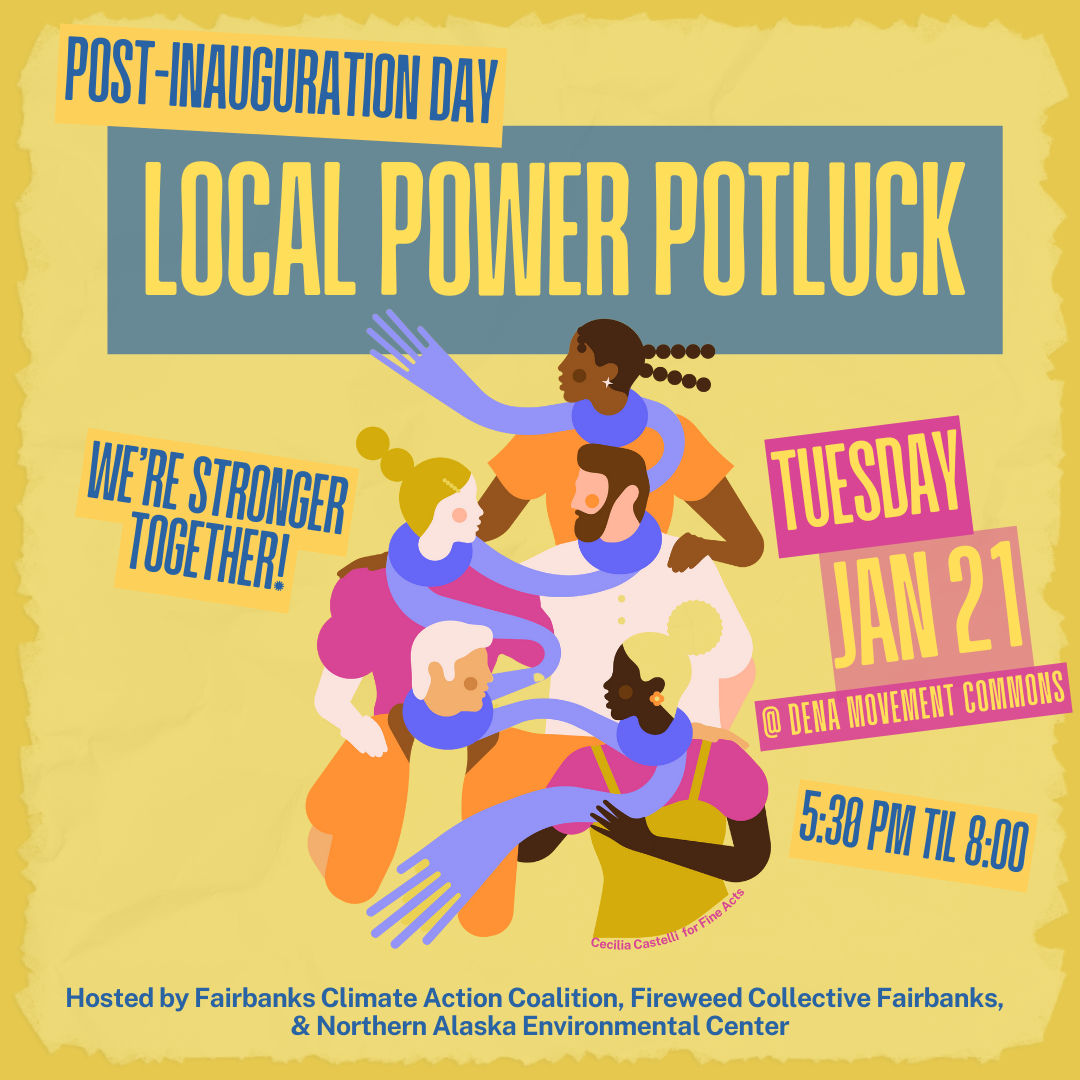
This brightly-colored infographic features a mustard yellow background with colorful blocky cartoon figures sharing a blue scarf that weaves around each of their five necks as they all embrace. The information reads: Post-Inauguration Day Local Power Potluck. We're stronger together! Tuesday, Jan. 21 at Dena Movement Commons from 5:30 p.m. until 8 p.m.. This event is hosted by Fairbanks Climate Action Coalition, Fireweed Collective Fairbanks, and Northern Alaska Environmental Center.

Illustration by Cecilia Castelli for Fine Acts

In these difficult moments, we lean on our community. Please join us for a community potluck of changemakers to share food, strengthen our relationships, and lean into what we can do to resist and continue to build the world we want in the midst of the political circumstances.  


This is in collaboration with Fairbanks Climate Action Coalition and Fireweed Collective Fairbanks.  All are welcome.  Bring a dish to share if you want to. This is an informal gathering with the goal of supporting local collaboration and support across Fairbanks. 


What: Post-Inauguration potluck and community gathering 

When: Tuesday, January 21 at 5:30 p.m.

Where: Dená Movement Commons in Fairbanks (526 Gaffney Rd., Suite 203)


For more information, please check out the Facebook event here. 


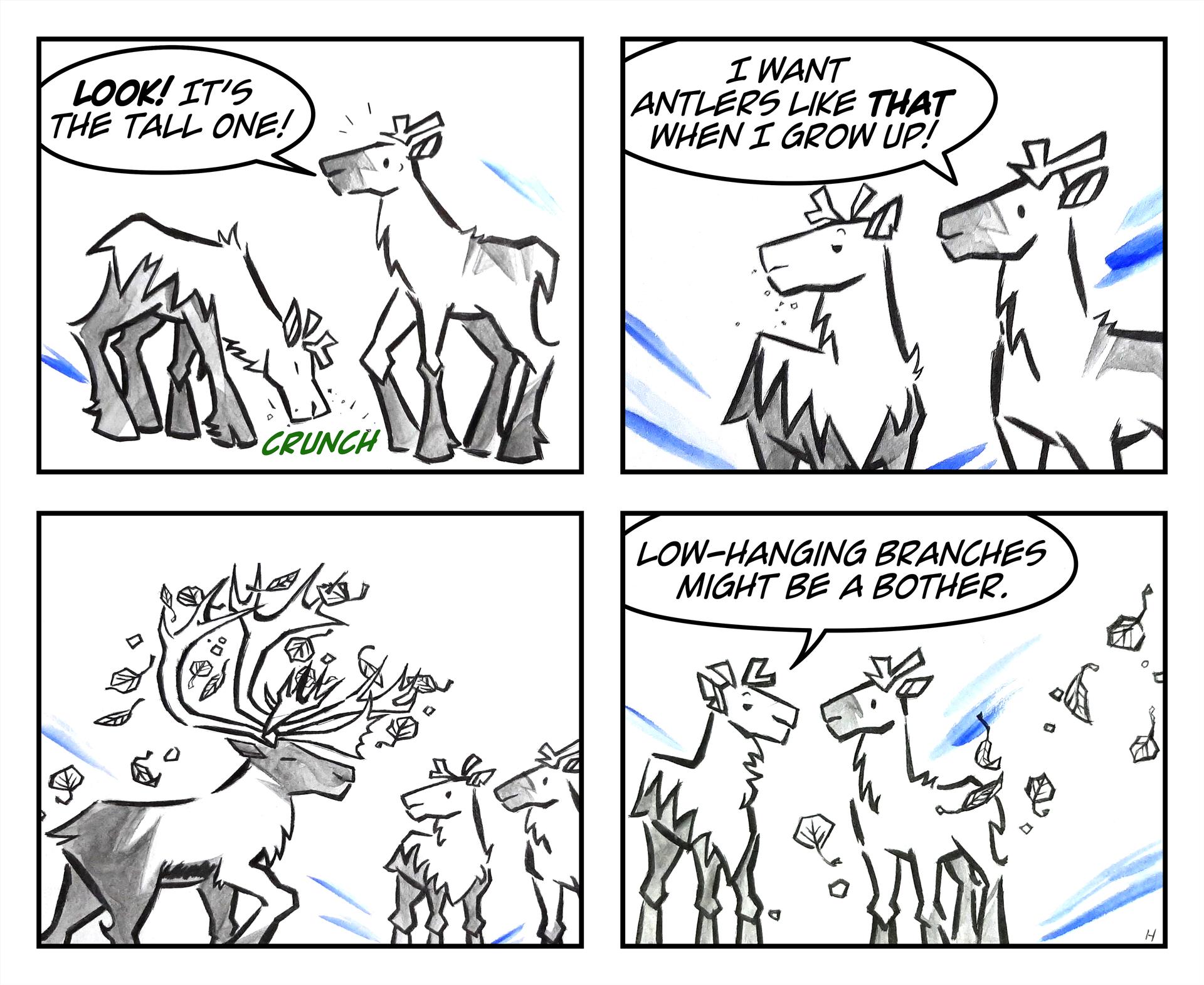
New art from Hazard Hughes!

In this four block comic strip, artist Hazard Hughes shows two cartoon caribou in black and white (with a blue streaky background) eating. One caribou says to the other, ''Look! It's the tall one!'' and the other caribou replies, ''I want antlers like THAT when I grow up!'' The third comic strip shows a large bull caribou emerging with lots of leaves on its antlers. The final block of the cartoon shows the two original caribou with one stating, ''Low-hanging branches might be a bother.''
 

Don't miss out on these important reads

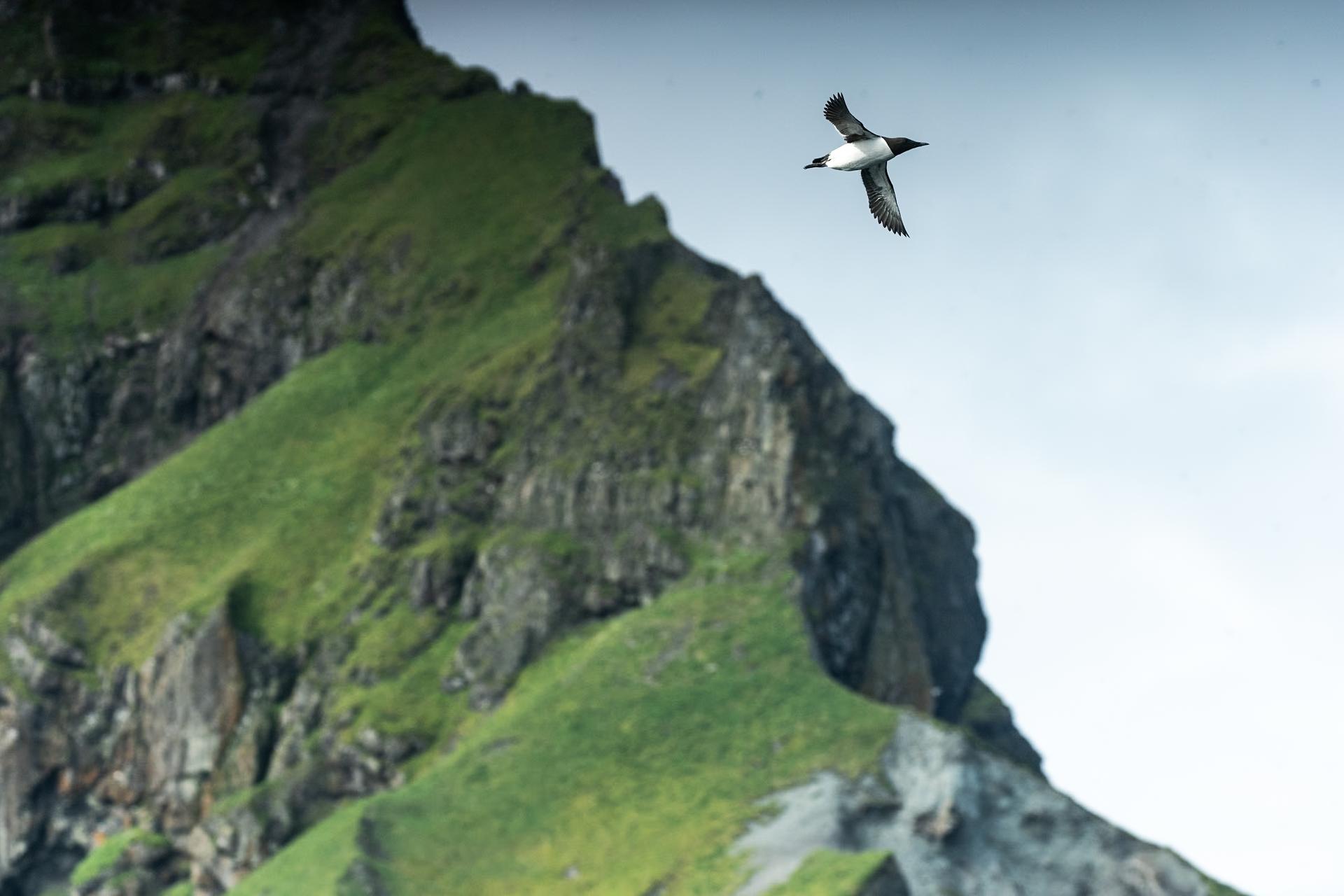
A common murre flies above Hall Island in the Bering Sea. Photo by Nathaniel Wilder

The bird at the center of the worst single-species mortality event in modern history isn’t recovering, scientists say


In this article by Julianna Bragg for CNN, learn more about a mass die-off of approximately half of Alaska’s common murre population, killed by a yearslong marine heat wave, and what their recovery looks like now. “There are about 8 million people in New York City, so it would be like losing half of the population … in a single winter,” said Brie Drummond, a wildlife biologist at the Alaska Maritime National Wildlife Refuge.

A community’s fight to save Unangam Tunuu on St. Paul Island


"Unangam Tunuu is only taught in only a handful of classes in the public school system, and outside these sessions, the language is seldom spoken," writes Theo Greenly for KUCB. “The struggle on St. Paul mirrors trends across Alaska. A 2024 report from the Alaska Native Language Preservation and Advisory Council...found that all of the state’s Indigenous languages are critically endangered, with some spoken by fewer than a dozen people.”


Other News and Updates


  • Thank you to everyone who has already completed our short E-Newsletter survey–your thoughtfulness and suggestions have been greatly appreciated and heard! If you haven't yet, please help us out by completing our short survey no later than Monday, Jan. 27 to be automatically entered into a drawing for a brand new pair of NOCS Provisions binoculars! 
  • Job Opening: Camp Denali, in Denali National Park and Preserve, is hiring naturalist guides for the 2025 season. For more information, click here.

  • Fairbanks Climate Action Coalition is hiring a Keep It In the Ground (KING) Organizer. You can find the job description here. This role is great for someone who is passionate about climate justice, is fired up about the way extractive industries function in Alaska and wants to be part of building a movement to dismantle unjust systems and build a healthier future for our community and the land.

  • Alaska Wilderness League is hiring a campaign director for the Arctic Defense Campaign. To apply, submit a resume and cover letter that expresses your interest in Alaska public lands conservation and your top two or three skills that will allow you to be successful in this role to Jobs@defendthearctic.org. This position is open until filled and application reviews will be on a rolling basis, with priority consideration given to applications received by January 17.
  • The Alaska Marine Science Symposium is January 27-31 in Anchorage. The Symposium will bring together scientists, educators, resource managers, students, and interested public to discuss the latest marine research being conducted in Alaskan waters. To register, or for more information, click here.
  • Governor Mike Dunleavy released a report detailing what he considers the top priorities for the incoming administration as they relate to resources in Alaska. His primary targets include the Ambler Road, Arctic Refuge, NPR-A, and other issues that he considers impediments to resource development and state primacy of Alaska’s lands and waters. Read the full report here.
 

MISSION

The Northern Alaska Environmental Center promotes conservation of the environment and sustainable resource stewardship in Interior and Arctic Alaska through education and advocacy.

Facebook Instagram

Our Contact Information

*{{Organization Name}}*

*{{Organization Address}}*

*{{Organization Phone}}*

*{{Organization Website}}*


*{{Unsubscribe}}*